
Last updated: September 18, 2026
Published September 18, 2026 · Updated September 18, 2026
The short version of how to measure a dress shirt I already own: lay your best-fitting shirt flat and buttoned on a hard surface, then record four numbers, collar, chest, back length and sleeve, because those are exactly the four measurements the HADUR size guide lists, all taken on the shirt laid flat. Do not measure your neck. Do not trust the label. Measure the garment that already fits you.
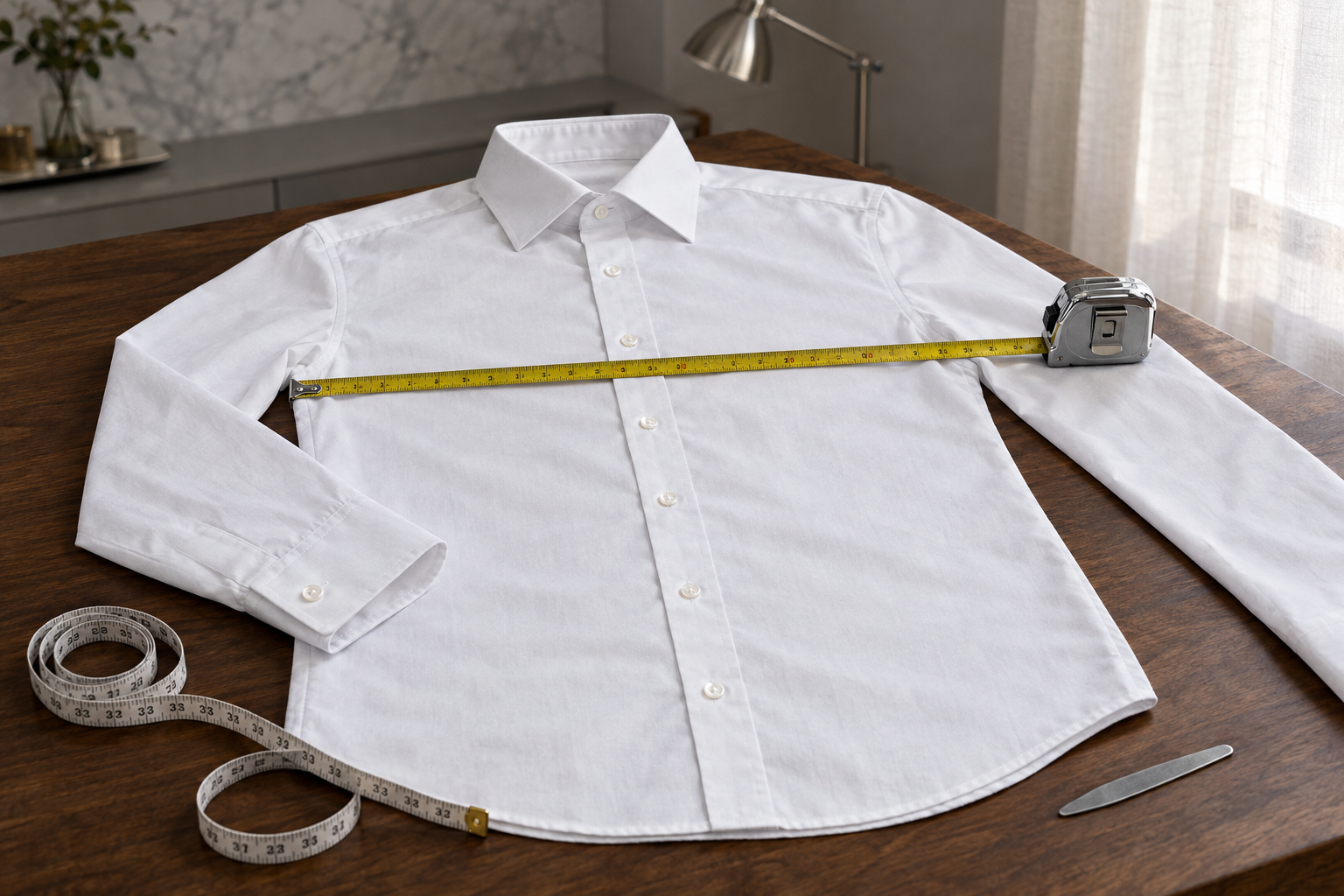
- The HADUR size guide lists four measurements: collar, chest, back length and sleeve, all measured on the shirt laid flat, so measure your own shirt flat too.
- HADUR sizes are collar sizes in centimetres with the inch size printed beside them, which means you can work in either unit without doing conversion math yourself.
- Chest is the number most men get wrong: a flat chest measurement is taken across the shirt, so it represents roughly half the body circumference, not the whole way around.
- HADUR sells exactly two shirts, both white, both $40: the Camicia in 100% bamboo (breathable, moisture-wicking) and the Raffinato in cotton with stretch that moves with you and holds a crisp line. Both have a non-iron finish and a refined spread collar.
- Returns and exchanges are accepted within 30 days on unworn shirts in new condition, with the customer paying return shipping, so a measurement that lands between sizes is not a dead end.
- Measure a clean, dry shirt that has been washed the way you normally wash it, because a shirt measured fresh off the shelf and a shirt measured after ten washes are two different shirts.
The Short Answer: How to Measure a Dress Shirt I Already Own
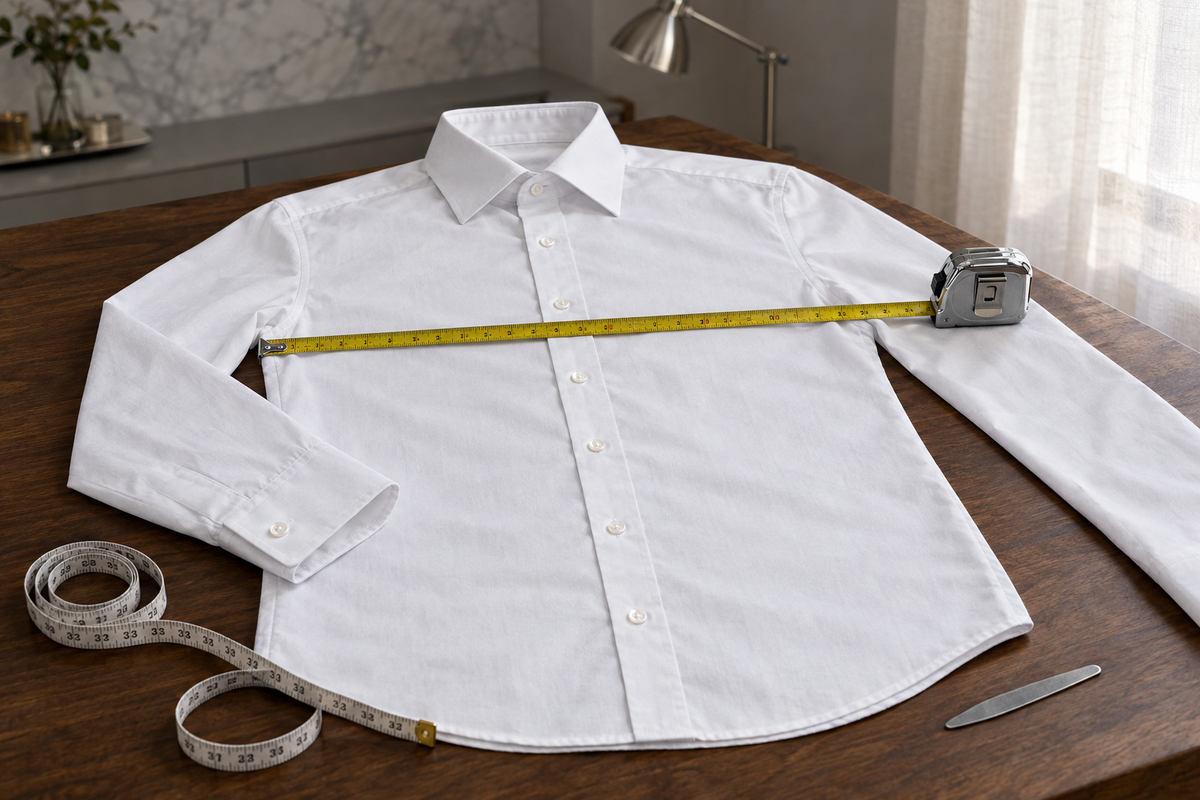
To work out how to measure a dress shirt I already own, button the shirt fully, lay it face down on a table or a made bed, smooth the wrinkles out with your palm, and take four numbers with a flexible tailor's tape: the collar (laid open, from the centre of the button to the far edge of the buttonhole), the chest (straight across the shirt about 2.5 cm below the armholes), the back length (from the base of the collar seam straight down to the hem), and the sleeve (from the shoulder seam to the end of the cuff). Write them down in centimetres. Then compare them to the HADUR size guide, which lists those same four fields, measured the same way, on the shirt laid flat.
That is the whole method. It takes about four minutes and it is more reliable than any size you remember from a store change room. If you're a man in Thornhill or Vaughan who has been buying the same collar number since some wedding years ago, and the shirts keep feeling tight at the throat or balloon at the waist, the tape will tell you why in one pass.
The Full Answer
The method above works. The details below are what separate a measurement you can order from and a measurement that sends a shirt back through Canada Post. Honestly, the part most men rush is the flattening, not the measuring.
1. Choose the right shirt, not the newest one
Pick the dress shirt in your closet that you actually reach for, the one you'd wear to a meeting at 8 a.m. without thinking about it. Not the stiff one you bought for an interview and never liked. Not the one from a decade ago that you keep because it was expensive.
The pattern we see most is men measuring their worst-fitting shirt because it happens to be the cleanest one in the drawer. You are copying a fit, not auditing a wardrobe. If two shirts fit well, measure both and note where they differ; that gap tells you how much variation you tolerate.
2. Lay it flat, properly, on something hard
A shirt measured on a sofa cushion reads long. A shirt measured on a kitchen table reads true. Button it from the top button to the bottom, including the collar button, turn it face down, and run your hand across the back until the side seams sit straight and parallel. Sleeves folded flat along the shirt, cuffs buttoned.
Do not stretch the fabric. This matters more with a cotton stretch shirt than with a woven that has no give: pull a stretch shirt taut and you can add a couple of centimetres that do not exist. Lay the tape on the fabric, don't press it in.
3. The four numbers, one at a time
Unbutton the collar, lay it open and flat, and measure from the centre of the button to the far edge of the buttonhole. This is the number HADUR lists as the size, in centimetres with the inch size beside it.
Measure straight across the shirt, roughly 2.5 cm below the armhole seams, from one side seam to the other. Keep the tape level with the hem. This is a flat measurement, so it covers half the body, not the full way around.
From the seam where the collar joins the back of the shirt, straight down the centre to the bottom hem. Follow the shirt, not a curve, and don't include the collar itself.
From the shoulder seam at the top of the arm, along the outside of the sleeve, to the end of the cuff. Note which reference point you used, because some charts start at the centre back of the collar instead, which adds the width of half your shoulders.
| Measurement | Where the tape goes | The common mistake |
|---|---|---|
| Collar | Button centre to buttonhole far edge, collar laid open | Measuring the neck instead of the collar, then adding a guess |
| Chest | Across the shirt, about 2.5 cm under the armholes, seam to seam | Doubling it and comparing the doubled figure to a flat chart |
| Back length | Collar seam at the back, straight down to the hem | Starting at the top edge of the collar, adding several centimetres |
| Sleeve | Shoulder seam to cuff edge, sleeve folded flat | Mixing a centre-back-to-cuff number with a shoulder-to-cuff chart |
4. Centimetres, inches, and why HADUR prints both
HADUR gives sizes as collar measurements in centimetres with the inch size beside them. That is deliberate. Canada runs on metric officially, most men's dress shirts sold in North America are labelled in inches, and plenty of men in the GTA grew up with one system and buy clothes in the other.
Work in whichever unit your tape shows most clearly, then read across. One inch is 2.54 cm, so the arithmetic is simple, but rounded conversions drift: a rounded centimetre figure can sit half a size off an inch figure. When the two disagree, use the centimetre number, because that is the finer measurement.
5. Comparing your numbers to the Camicia and the Raffinato
HADUR sells two shirts, both white, both $40. The Camicia is 100% bamboo: breathable, moisture-wicking, non-iron finish, refined spread collar. The Raffinato is cotton with stretch: it moves with you, holds a crisp line, non-iron finish, refined spread collar. More colours are on the way; white is what we have now.
Fabric changes how a fit feels at the same measurement. A cotton shirt with stretch gives at the chest when you reach across a desk, so a number that reads snug on the tape can still wear comfortably. A woven bamboo shirt has the measurement it has, which is why the collar and chest numbers deserve a second read before you order the Camicia.
6. What to do when your numbers land between sizes
If your collar measurement sits between two sizes on the size guide, prioritize the collar. The collar is the one measurement a tailor cannot fix and the one you feel every hour of a long day at a desk or a long evening at a wedding.
Then use the other three numbers as tie-breakers. If your chest and back length both point up, go up. If they point down and only the sleeve points up, remember that a sleeve is the easiest alteration on a dress shirt and the least expensive one any tailor in Vaughan will quote you. Or send your four numbers to hadurclothing@gmail.com and we will tell you which size we'd put you in.
When the Answer Is Different
Measuring a dress shirt you already own is the right approach in most cases. Here are the situations where the standard method needs an adjustment before you order the Camicia or the Raffinato at $40 each.
The shirt has shrunk, and you know it
If your reference shirt has been through a hot wash and a hot dryer for years, you are measuring a shrunken garment and copying its shortcomings. The tell is usually the back length and the sleeve: the collar still does up, but the hem rides out of your waistband when you sit.
In that case, measure it anyway, note it as a shrunken baseline, and treat the length numbers as a floor rather than a target. Then wash your new shirt the way it should be washed: cold, gentle cycle, no bleach, no fabric softener, hang it while it is still damp, cool iron if you want a sharper line. That routine is why a non-iron finish stays useful past the first month.
Your reference shirt was altered or made to measure
A shirt that has been taken in at the sides, or had back darts added, will give you a chest measurement that no ready-to-wear chart matches. Measure the chest at the armholes as usual, then also measure across the shirt at your natural waist and note both.
The honest advice here: order by collar and chest, wear the shirt once in front of a mirror, and decide whether you want a tailor to bring the waist in. That is a small, cheap alteration on a white shirt and it is how most men in the GTA get a ready-to-wear shirt looking made for them.
You're buying the shirt as a gift
Measuring someone else's shirt while they are out of the house is a legitimate tactic, and it works better than asking them their size. Take the four numbers off a shirt from the middle of their closet, not the one at the front of the rail, which is often the one they never wear because it doesn't fit.
You'd rather not measure at all
Then come and try one on. The HADUR showroom is in Thornhill, Ontario, by appointment only, and appointments are made by phone at +1 (647) 490-1901 or by email at hadurclothing@gmail.com. Ten minutes with both shirts on your shoulders settles the question faster than any tape.
If you're ordering from farther away, HADUR ships across Canada and the United States, and the shipping policy is shown at checkout. Returns and exchanges are accepted within 30 days on unworn shirts in new condition, with the customer paying return shipping.
Our take after years of fitting white dress shirts
Men overweigh the number on the label and underweigh the collar seam. We see it constantly: a man is certain of his size because a store in a mall told him so in 2014, and the shirt he is wearing while he says it has a collar gap you could fit two fingers into. The label is a manufacturing convention. The tape is a fact.
What actually matters, in order: the collar, the chest, then everything else. Get the collar right and a spread collar sits clean under a jacket and behaves with or without a tie. Get the chest right and the shirt stops pulling at the placket when you reach for a boardroom pen or a prayer book. Back length and sleeve are comfort and proportion, and both are fixable by a tailor for less than the shirt costs.
The one thing we'd tell a friend: do the measuring once, write the four numbers in your phone under "shirt", and you will never have to think about this again. It is four minutes of work that outlives the shirt you measured. And if the numbers put you between sizes on the Camicia or the Raffinato, email them to us instead of flipping a coin.
FAQ
How do I measure a dress shirt I already own without a tailor's tape?
Measuring a dress shirt you already own without a tailor's tape is doable with a length of string and any metric ruler: lay the string along the collar, chest, back length and sleeve, mark it, then measure the string against the ruler in centimetres. A retractable metal tape from a toolbox also works for back length and sleeve, though it fights you on the curve of a collar. Record all four numbers in centimetres, since the HADUR size guide gives collar sizes in centimetres with the inch size beside them.
Should I measure my neck or the shirt's collar?
Measure the shirt's collar, not your neck, because the HADUR size guide lists collar, chest, back length and sleeve as measured on the shirt laid flat. A collar measurement (button centre to buttonhole edge, collar laid open) compares directly against that chart, while a neck circumference requires you to guess how much room you want. If you only have a neck measurement, phone +1 (647) 490-1901 and we will work the size out with you.
Do the Camicia and the Raffinato use the same measurements?
The Camicia and the Raffinato are both listed by collar size in centimetres with the inch size beside them, and both are $40, but you should read each product page's size guide rather than assume the four flat figures are identical. The Camicia is 100% bamboo, breathable and moisture-wicking; the Raffinato is cotton with stretch that moves with you and holds a crisp line, so the same measurement wears differently on each. Both have a non-iron finish and a refined spread collar.
What happens if I measure wrong and order the wrong size?
HADUR accepts returns and exchanges within 30 days on unworn shirts in new condition, and the customer pays return shipping, so a mismeasured order is an exchange rather than a loss. Keep the shirt unworn until you have checked the collar and chest against your own numbers. For delivery details across Canada and the United States, see the shipping policy at checkout.
Sources
- Shirt fabrics, collar style, $40 price and available colours for the Camicia and Raffinato - HADUR Fine Men's Clothing
- Size guide fields (collar, chest, back length and sleeve measured on the shirt laid flat) and collar sizes in centimetres with inches beside them - HADUR Size Guide
- Canada's official use of the metric system for measurement, which is why collar sizes are given in centimetres first - Measurement Canada
- 30-day returns and exchanges on unworn shirts in new condition, customer pays return shipping, and shipping details shown at checkout - HADUR store policies
HADUR
Have your four numbers? Compare them to the size guide for the Camicia in 100% bamboo and the Raffinato in cotton with stretch, both white, both $40. Still between sizes, or want to try both on in Thornhill? Email hadurclothing@gmail.com or call +1 (647) 490-1901 to book the Thornhill showroom.
Check Your Collar Size Against Both HADUR Shirts →